
The Pyromation K48 Thermocouple: The Industrial Benchmark for High-Temperature Measurement

The Industrial Benchmark for High-Temperature Measurement
The Pyromation K48 series represents the optimized versatility of industrial temperature sensing, balancing mechanical durability with high-precision thermoelectric response. Defined by its Type K (Chromel/Alumel) calibration, 1/4″ O.D. profile, and Magnesium Oxide (MgO) insulation, the K48 is the most widely specified thermocouple configuration in heavy industry.
Engineered for multiple applications, the K48 is designed to perform in oxidizing and inert atmospheres at temperatures reaching up to 2,300°F (1,260°C). Its construction utilizes a high-purity MgO powder, compacted around the thermoelements and encased in a 316 Stainless Steel or Inconel® sheath. This design provides superior dielectric strength and protects the internal elements from the mechanical fatigue caused by high-vibration environments, such as turbine exhausts, industrial furnaces, and chemical reactors.
By standardizing on the K48 platform, facilities achieve a reduction in spare-parts inventory while maintaining a sensor capable of surviving the most demanding thermal cycles. Whether utilized as a standalone probe or as the primary element within a thermowell assembly, the K48 provides the linear voltage output and long-term stability required for critical PLC and DCS control loops.
Table of Contents
Mechanical Construction and Material Science
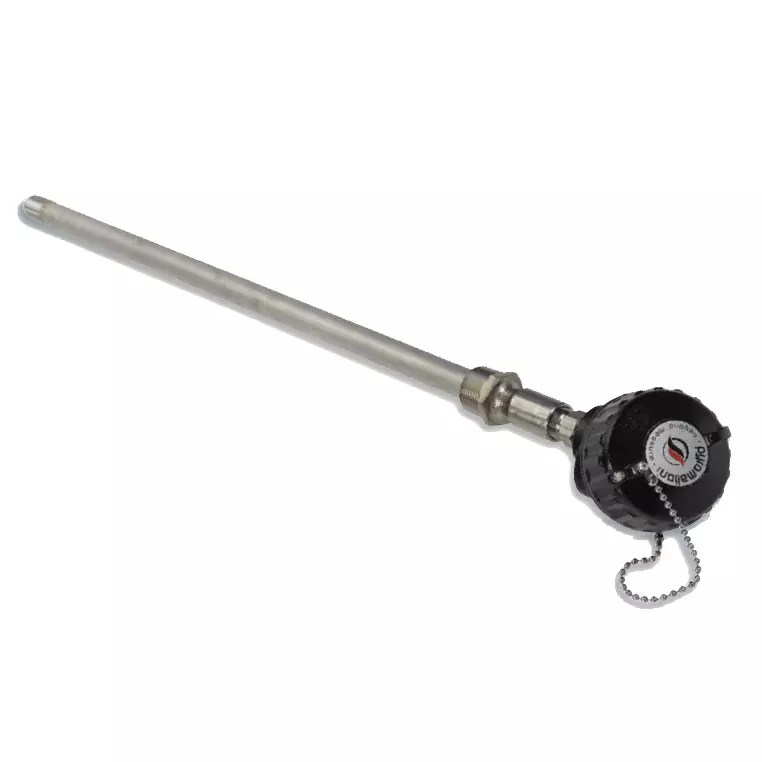
The mechanical integrity of the K48 thermocouple is derived from its “compacted” architecture. Unlike basic wire sensors, the K48 utilizes a mineral-insulated (MI) construction that treats the sheath, insulation, and conductors as a single, homogenous cable. This section details the material properties that allow this assembly to withstand extreme thermal and mechanical stresses.
Sheath Metallurgy: 316 Stainless Steel
In the Pyromation nomenclature, the -8- represents 316 Stainless Steel, the industry standard for high-performance sheathing.
- Corrosion Resistance: The addition of molybdenum (2–3%) provides 316SS with superior resistance to chlorides and pitting compared to 304SS.
- Temperature Limits: While 316SS maintains structural integrity up to 1,650°F (900°C), it is primarily selected for its oxidation resistance in mid-to-high temperature process loops.
- Structural Rigidity: The 1/4″ (0.250″) O.D. wall thickness ensures the probe does not sag or deform under its own weight when cantilevered in horizontal furnace mounts.
Magnesium Oxide (MgO)
The internal volume of the K48 is high-pressure packed with 96% minimum purity Magnesium Oxide.
- Vibration Dampening: Because the MgO is compacted to a rock-hard consistency, the internal Chromel and Alumel wires are immobilized. This prevents mechanical fatigue and cold working of the conductors in high-vibration applications like reciprocating engines or turbine exhausts.
- Thermal Conductivity: Despite being an electrical insulator, compacted MgO is an excellent thermal conductor, ensuring that heat from the process environment reaches the sensing junction with minimal thermal lag.
The 1/4″ O.D. Designation
The selection of a 1/4″ (0.250″) outer diameter represents a strategic engineering compromise between mechanical strength and thermal sensitivity. In the Pyromation catalog, where diameters range from 0.040″ to 0.375″, the -4- designation is the industrial standard due to the following technical parameters:
- Mechanical Loading and Structural Rigidity: A 0.250″ sheath provides significantly higher moment of inertia compared to 1/8″ or 3/16″ alternatives. This prevents “bore-lock” caused by probe sagging in horizontal thermowell installations and ensures the sensor can withstand high-velocity process flows without mechanical failure.
- Thermal Response Time : While larger diameters (e.g., 3/8″) offer greater longevity, the 1/4″ O.D. maintains a lower thermal mass. This results in a faster time constant, which is critical for high-speed PID control loops.
- Dimensional Standardization: The 0.250″ O.D. is the primary reference dimension for the majority of industrial hardware. This ensures high interchangeability with standard NPT compression fittings, bayonet adapters, and the internal bore diameters of machined bar-stock thermowells (typically 0.260″ or 0.385″).
Reading the Part Numbers
The Pyromation coding system follows a structured hierarchy. By isolating these segments, engineers can precisely define the sensor’s performance envelope.
[Calibration] [Diameter] [Material] [Junction] – [Length] – [Termination]
So, a number like K48U-012-00-8HN31 would have a part number construction as follows:
| Segment | Code | Technical Variable | Engineering Definition |
|---|---|---|---|
| Calibration | K | Thermoelement Type | Type K (Chromel/Alumel) per ASTM E230. |
| Diameter | 4 | Sheath O.D. | 0.250″ (1/4″) Outer Diameter. |
| Material | 8 | Sheath Alloy | 316 Stainless Steel (Standard Corrosion Resistance). |
| Junction | U | Wiring Configuration | Ungrounded (Thermoelements isolated from the sheath). |
| Length | 012 | Immersion (“L”) | Measured in inches (e.g., 12″). |
| Termination | 31 | Connection Head | Aluminum screw-cover head (NEMA 4 rated). |
Thermoelectric Performance Data
The performance of a K48 thermocouple is governed by two primary factors: the metallurgical purity of the Chromel/Alumel wires (accuracy) and the thermal mass of the 0.250″ MgO-insulated sheath (response time).
The Junction Type (U vs. G)
The “U” (Ungrounded) designation is the industrial preference for modern control systems. Unlike a Grounded (G) junction, where the wires are welded directly into the sheath tip, the Ungrounded junction is physically and electrically isolated. This prevents “ground loops” that can interfere with PLC and DCS analog input cards and provides high-voltage protection between the process media and the instrumentation.
The Sheath Material (8 vs. 3)
While the “8” (316SS) is the most common for chemical and general-purpose use, high-heat applications often require a transition to the “3” (Alloy 600/Inconel®). Code 8 (316SS) is best for aqueous solutions and temperatures below 1,650°F. Code 3 (Alloy 600) offers superior resistance to oxidation and stress-corrosion cracking in temperatures up to 2,150°F.
The Termination (Head Style)
The suffix (e.g., 31) defines how the sensor connects to the rest of the temperature loop. Code 31 is Cast Aluminum (General Purpose); Code 91 is 316 Stainless Steel (Wash-down or Highly Corrosive environments); Code 22 is Polypropylene (Acidic or Low-Temp Chemical environments).
Limits of Error (Accuracy Standards)
The accuracy of a Type K thermocouple is defined by its “Limits of Error” according to ASTM E230. Pyromation offers two tiers of precision for the K48 series:
| Tier | Tolerance (whichever is greater) | Temperature Range |
|---|---|---|
| Standard Limits | ± 2.2°C or 0.75% | 0°C to 1,260°C (32°F to 2,300°F) |
| Special Limits | ± 1.1°C or 0.4% | 0°C to 1,260°C (32°F to 2,300°F) |
Industrial Applications and Environmental Suitability
The K48’s 0.250″ MgO-insulated construction is engineered to thrive in environments that would cause standard wire sensors to fail due to moisture ingress, oxidation, or mechanical fatigue.
Chemical and Petrochemical Processing
The 316 Stainless Steel sheath (Code 8) is the primary defense against corrosive media. They have excellent resistance to organic acids, fatty acids, and many chloride environments at moderate temperatures. In cases where high-concentration sulfuric acid or reducing environments are present, engineers should specify Alloy 600 (Code 3).
Power Generation and Turbine Exhaust
High-velocity gas streams and turbine vibrations require a sensor with high resonant frequency and mechanical damping. The compacted MgO powder acts as a continuous dampener for the internal thermoelements. This prevents the work-hardening and subsequent brittle fracture of the Chromel/Alumel wires that occurs in loosely insulated sensors.
Heat Treating and Industrial Furnaces
Type K thermocouples are specifically designed for oxidizing atmospheres. At temperatures up to 2,300°F, the Chromel-Alumel pair relies on a thin, protective oxide layer to remain stable. The K48’s sealed sheath prevents the depletion of this layer by limiting the available oxygen to what is trapped within the MgO matrix.
Comparative Analysis: K48 vs. J48
While the J48 (Type J, 1/4″ O.D., 316SS) shares the same physical dimensions as the K48, their metallurgical properties dictate vastly different operational boundaries.
- Thermal Ceiling: The K48 is rated for continuous use up to 2,300°F (1,260°C). In contrast, the J48 is limited to 1,400°F (760°C).
- Oxidation vs. Reduction: The Type K element is optimized for oxidizing atmospheres. The Type J element is highly susceptible to oxidation; the iron leg will rust and scale if moisture is present.
- EMF Output (Sensitivity): Type J provides a higher Seebeck coefficient than Type K. Modern PLC/DCS input cards, however, easily resolve the Type K signal, making the K48 the preferred standard for new installations.
Installation and Mounting Specifications
Proper installation of the K48 is essential to ensure that the sensor’s mechanical longevity matches its thermoelectric accuracy. The 0.250″ O.D. allows for several standardized mounting configurations.
| Mounting Type | Connection Code | Application | Best For |
|---|---|---|---|
| Compression Fitting | 04 | Adjustable depth through NPT port. | Tanks, piping, and pressurized ducts. |
| Spring-Loaded | SL | Maintains tip contact in thermowells. | High-vibration motors and pumps. |
| Fixed Bushing | 01 | Welded or brazed to a set immersion length. | High-pressure vessels and permanent installs. |
Procurement Checklist for Engineers
- Immersion Length (“L” Dimension): Calculate based on the “10x Diameter” rule (min. 2.5″) plus standoff distance.
- Junction Type: Specify Ungrounded (U) for PLC/DCS integration to ensure signal isolation.
- Sheath Material: Confirm 316 Stainless Steel for corrosion or Alloy 600 for temperatures exceeding 1,650°F.
- Termination Head: Select Aluminum (31) or Stainless Steel (91) for NEMA 4X protection.
For more information on these products, please contact TCI Supply today.