

Schneider Electric Relays, Contactors, and Motor Protection Guide
In industrial automation and motor control, accuracy in sourcing parts can make the difference between seamless operations and costly downtime. Many facilities rely on Schneider Electric equipment because of its reputation for durability, global availability, and ease of integration into a wide range of control systems. From contactors to overload relays and molded case circuit breakers (MCCBs), Schneider has built a comprehensive lineup of components that remain industry standards across commercial, manufacturing, and utility applications.
One of the most common challenges in the field is navigating the complexity of part numbers. Over time, product families evolve, coil voltage options expand, and older Telemecanique or Square D models are consolidated under the Schneider Electric brand. A technician sourcing a TeSys D contactor or an LRD overload relay needs confidence that the part will match both the electrical requirements and the mechanical mounting of the system already in place. Even a minor mismatch in coil voltage or trip range can result in delays, additional costs, or system malfunctions.
That is why reliable part references are essential. Having access to organized tables of Schneider Electric part numbers, specifications, and compatibility notes allows buyers and engineers to cross-check replacements quickly. It also helps avoid confusion when dealing with discontinued items or when trying to identify modern equivalents for legacy products.
This guide focuses on three cornerstone categories of Schneider Electric’s motor control and protection portfolio:
- TeSys contactors: compact, modular devices that serve as the backbone of motor starting and switching.
- Overload relays: adjustable protective units that safeguard motors from overheating and extended overcurrent conditions.
- MCCBs and switchgear: higher-capacity protection devices used in feeders and distribution circuits.
By understanding these product families and their part numbering, you will be better prepared to identify, specify, and source the right Schneider Electric components for your applications.
Key Product Categories
A. Schneider Electric Contactors (TeSys Range)

Schneider Electric’s TeSys contactors are among the most widely recognized motor control devices in the world. Built for reliability and modularity, they provide safe switching of motors, heaters, and other electrical loads. The TeSys range includes the compact TeSys K series for smaller loads and the versatile TeSys D series for a broad spectrum of motor control applications.
Key Features:
- Wide range of coil voltages (AC and DC) for global compatibility
- Plug-in auxiliary contact blocks and interlocks for flexible control schemes
- Compact DIN-rail mounting for quick installation
- Designed for use with Schneider overload relays to create complete motor starters
Applications: TeSys contactors are found in OEM machinery, HVAC systems, conveyor lines, pumps, and nearly any motor-driven process. They are especially valued in industrial panels where modularity and standardized mounting reduce assembly time.
B. Overload Relays
To protect motors from overheating or long-term overcurrent, Schneider Electric pairs its contactors with thermal overload relays, such as the LRD series. These relays mount directly onto TeSys contactors to create an integrated starter solution. Adjustable trip ranges allow one relay type to cover multiple motor sizes, simplifying stocking and maintenance.
Key Features:
- Adjustable settings for precise motor protection
- Direct mounting onto contactors (reduces wiring and footprint)
- Manual or automatic reset options
- Clear status indicators for trip and reset functions
Applications: Overload relays are commonly installed in motor control centers, pump stations, HVAC compressors, and industrial machines where protecting motors against damage is a priority.
C. MCCBs and Switchgear
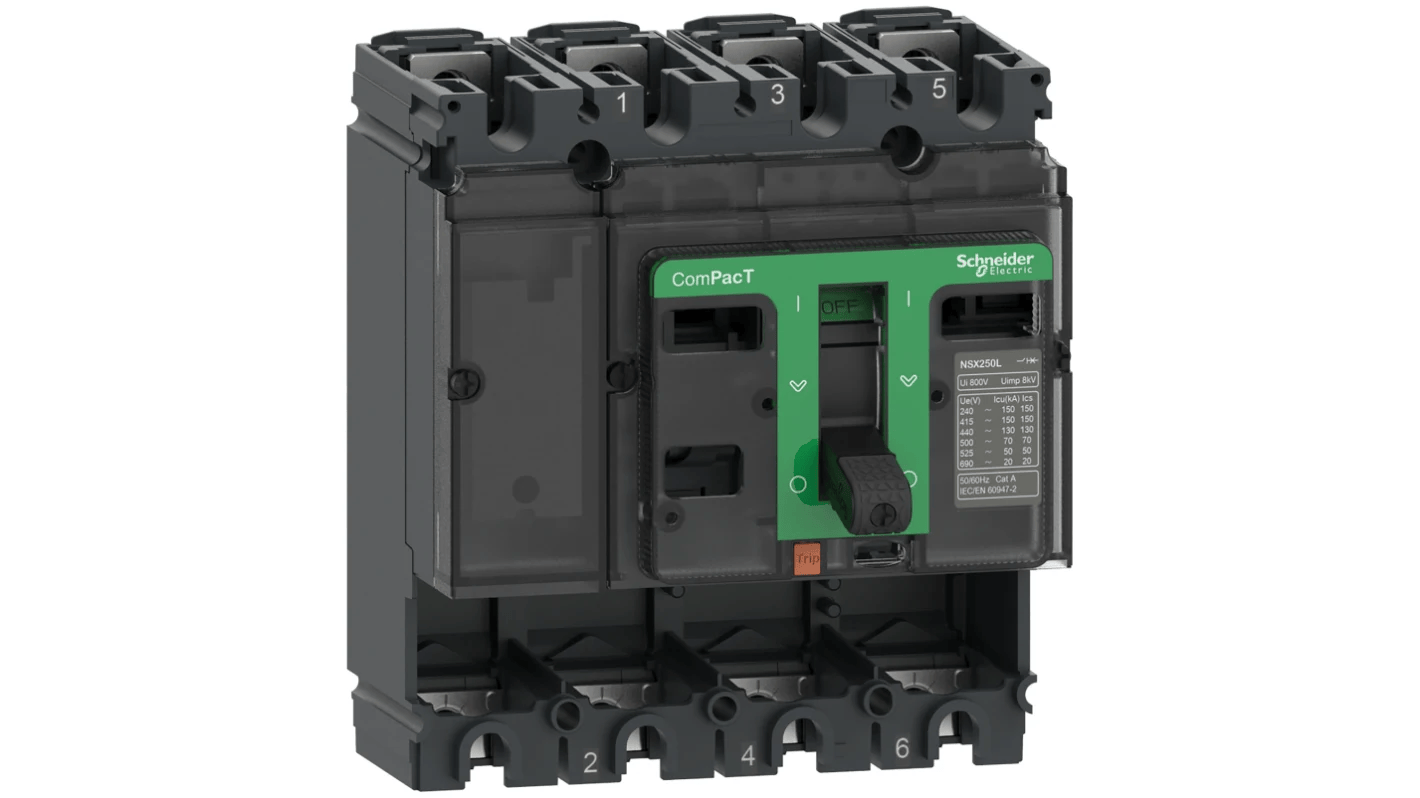
At higher current levels, protection and switching are handled by Molded Case Circuit Breakers (MCCBs) such as the Compact NSX series. These devices are designed to interrupt fault currents, protect feeders, and provide coordination with downstream contactors and relays. MCCBs form a critical link in motor protection schemes and plant distribution systems.
Key Features:
- Current ratings from 100 A up to several thousand amps
- Wide range of trip units, including thermal-magnetic and electronic
- 3-pole and 4-pole options for different system requirements
- Built-in accessories for shunt trip, under-voltage release, and auxiliary signaling
Applications: MCCBs are widely used in motor feeders, distribution panels, switchboards, and large machinery where reliable protection and coordination with motor starters are essential.
| Category | Model / Part Number | Rating / Voltage | Notes |
|---|---|---|---|
| Contactor (TeSys D) | LC1D09 | 9 A / 690 V | Standard motor starter, 24–600 V coil options |
| Contactor (TeSys D) | LC1D12 | 12 A / 690 V | Common for small motor loads |
| Contactor (TeSys D) | LC1D18 | 18 A / 690 V | DIN-rail or panel mount |
| Contactor (TeSys D) | LC1D25 | 25 A / 690 V | 3-pole standard design |
| Contactor (TeSys D) | LC1D32 | 32 A / 690 V | Handles mid-size motors |
| Contactor (TeSys D) | LC1D40 | 40 A / 690 V | Available with 110 V or 220 V coil |
| Contactor (TeSys D) | LC1D50 | 50 A / 690 V | Popular in HVAC panels |
| Contactor (TeSys D) | LC1D65 | 65 A / 690 V | Standard heavy-duty contactor |
| Contactor (TeSys D) | LC1D80 | 80 A / 690 V | High-current applications |
| Contactor (TeSys D) | LC1D95 | 95 A / 690 V | For larger industrial motors |
| Contactor (TeSys D) | LC1D115 | 115 A / 690 V | DIN and panel mounting options |
| Contactor (TeSys D) | LC1D150 | 150 A / 690 V | 3-pole, available with various coil voltages |
| Contactor (TeSys D) | LC1D185 | 185 A / 690 V | Motor starter for heavy industry |
| Contactor (TeSys D) | LC1D245 | 245 A / 690 V | High-capacity contactor |
| Contactor (TeSys D) | LC1D300 | 300 A / 690 V | Robust design for continuous duty |
| Contactor (TeSys D) | LC1D400 | 400 A / 690 V | Top-end of TeSys D range |
| Contactor (TeSys K) | LC1K06 | 6 A / 690 V | Compact design for small loads |
| Contactor (TeSys K) | LC1K09 | 9 A / 690 V | Space-saving motor starter |
| Contactor (TeSys K) | LC1K12 | 12 A / 690 V | High-density panel installations |
| Contactor (TeSys K) | LC1K16 | 16 A / 690 V | Compact DIN-rail mount |
| Reversing Contactor | LC2D09 | 9 A / 690 V | Reversing function built-in |
| Reversing Contactor | LC2D12 | 12 A / 690 V | Forward/reverse control |
| Reversing Contactor | LC2D18 | 18 A / 690 V | Compact reversing unit |
| Reversing Contactor | LC2D25 | 25 A / 690 V | Popular in conveyor applications |
| Overload Relay | LRD01 | 0.1–0.16 A | For fractional HP motors |
| Overload Relay | LRD02 | 0.16–0.25 A | Low current motor protection |
| Overload Relay | LRD03 | 0.25–0.4 A | Mounts directly on LC1D contactors |
| Overload Relay | LRD04 | 0.4–0.63 A | Thermal overload, adjustable |
| Overload Relay | LRD05 | 0.63–1 A | Small motor applications |
| Overload Relay | LRD06 | 1–1.6 A | Protects small induction motors |
| Overload Relay | LRD07 | 1.6–2.5 A | Used with LC1D09–D12 |
| Overload Relay | LRD08 | 2.5–4 A | Common motor starter relay |
| Overload Relay | LRD10 | 4–6 A | Popular mid-range protection |
| Overload Relay | LRD12 | 5.5–8 A | Adjustable trip setting |
| Overload Relay | LRD14 | 7–10 A | Fits LC1D18–D25 |
| Overload Relay | LRD16 | 9–13 A | Thermal-magnetic design |
| Overload Relay | LRD21 | 12–18 A | Direct mount on contactors |
| Overload Relay | LRD22 | 16–24 A | Motor feeder protection |
| Overload Relay | LRD32 | 23–32 A | Heavy-duty relay |
| Overload Relay | LRD33 | 30–40 A | Compatible with LC1D40–D50 |
| Overload Relay | LRD35 | 37–50 A | Adjustable trip curve |
| Overload Relay | LRD36 | 48–65 A | For LC1D65–D80 |
| Overload Relay | LRD37 | 63–80 A | High-current relay |
| Overload Relay | LRD38 | 80–104 A | For large motors |
| MCCB (Compact NSX) | NSX100F | 100 A / 3-pole | Feeder protection, thermal-magnetic |
| MCCB (Compact NSX) | NSX160N | 160 A / 3-pole | Industrial distribution panels |
| MCCB (Compact NSX) | NSX250F | 250 A / 3-pole | High-capacity MCCB |
| MCCB (Compact NSX) | NSX400N | 400 A / 3-pole | Standard protection unit |
| MCCB (Compact NSX) | NSX400H | 400 A / 3-pole | High breaking capacity |
| MCCB (Compact NSX) | NSX630N | 630 A / 3-pole | Large feeder protection |
| MCCB (Compact NSX) | NSX630H | 630 A / 3-pole | High-interrupt capacity |
| MCCB (Compact NSX) | NSX800N | 800 A / 3-pole | Heavy industrial systems |
| MCCB (Compact NSX) | NSX1000N | 1000 A / 3-pole | Large plant protection |
| MCCB (Compact NSX) | NSX1000H | 1000 A / 3-pole | High-performance MCCB |
Insights and Best Practices

Matching Contactors and Overload Relays
Schneider Electric designs its TeSys contactors and LRD overload relays to work together as integrated motor starters. The key is to size the overload relay according to the motor’s full load current (FLC) and then select the contactor to handle both the current and duty cycle. For example, a 9 A LC1D09 contactor pairs naturally with overload relays like LRD07 (1.6–2.5 A) or LRD08 (2.5–4 A) depending on the motor’s rating. This pairing ensures seamless mounting, reduces wiring errors, and provides coordinated protection.
Choosing the Right Coil Voltage
One of the most common mistakes in sourcing is overlooking the coil voltage on a contactor. Schneider part numbers often include a suffix that specifies coil voltage (for example, LC1D25M7 vs. LC1D25P7). Always confirm whether your control system uses 24 VDC, 48 VAC, 110 VAC, 220 VAC, or 480 VAC coils before ordering. Selecting the wrong coil voltage can result in equipment not pulling in, or worse, damaging the coil on energization.
Replacement Alternatives and Legacy Cross-References
Many technicians encounter older Telemecanique or Square D contactors and relays still in service. Schneider Electric has consolidated these brands, so part numbers may look unfamiliar. For instance, a legacy Telemecanique LC1-F series contactor will cross-reference to an equivalent TeSys D model today. When sourcing replacements, use the current Schneider Electric designation but confirm mounting footprint and auxiliary contact compatibility to ensure a true “drop-in” replacement.
Coordinating MCCBs with Starters
In larger systems, MCCBs like the NSX series provide feeder-level protection, while contactors and relays protect individual motors. Coordination between these devices ensures selective tripping: the overload relay trips on sustained overload, the MCCB trips on short-circuits, and the contactor provides control. Following Schneider’s coordination charts helps prevent nuisance tripping and ensures maximum uptime.
Stocking Recommendations
To minimize downtime, many facilities keep a small stock of common ratings on hand:
- TeSys D contactors in the 9 A, 18 A, and 32 A sizes
- Overload relays covering 2.5–4 A, 5.5–8 A, and 9–13 A ranges
- Compact NSX MCCBs in 100 A and 250 A ratings
Having these common parts on site allows maintenance teams to respond quickly without waiting for supply chain lead times.
Practical Tips for Sourcing
When it comes to Schneider Electric parts, accuracy and trust in your supplier are just as important as the technical specifications. The right contactor, relay, or MCCB can keep your systems running without interruption, but the wrong choice, or the wrong vendor, can result in costly downtime and headaches.
At TCI Supply, we make the process simple. Our team understands the details that matter most: coil voltages, auxiliary contact options, mounting styles, and compatibility with legacy Telemecanique or Square D models. Instead of chasing scattered distributors or waiting weeks for overseas shipments, you can rely on us to provide fast access to the parts you need, backed by technical knowledge and responsive customer support.
Why source from TCI Supply?
- Global reach, local support: We ship Schneider Electric parts worldwide while still giving you the personal attention of a dedicated partner.
- Extensive catalog: From TeSys contactors to LRD overload relays to Compact NSX MCCBs, our inventory covers the most in-demand products and ratings.
- Cross-reference expertise: Unsure whether your legacy Telemecanique or Square D part matches a current Schneider model? We’ll help you identify the modern equivalent and ensure a true fit.
- Reliable turnaround: We know downtime is expensive. Our sourcing network and quick-ship options are designed to keep your operations moving.
Whether you’re maintaining a small HVAC system or outfitting a full industrial plant, sourcing through TCI Supply means peace of mind. You’ll know your Schneider Electric components are authentic, properly matched to your application, and delivered with the urgency your business demands.
Conclusion

Schneider Electric has built its reputation on reliable, modular, and globally recognized solutions for motor control and protection. From TeSys contactors to LRD overload relays to Compact NSX MCCBs, these components form the backbone of countless industrial and commercial systems. Understanding how part numbers connect to ratings, coil voltages, and applications makes it easier to source the right products, minimize downtime, and keep operations running smoothly.
But having the right technical knowledge is only half the battle—choosing the right supplier is what makes the difference when time is critical. At TCI Supply, we specialize in helping customers cut through the complexity of Schneider Electric part numbers. Whether you’re replacing a legacy Telemecanique unit, cross-referencing an older Square D component, or building out a new system with current TeSys and NSX parts, our team is ready to assist.
When you need authentic Schneider Electric products, fast delivery, and support from people who understand the industry, TCI Supply is your trusted source.
FAQ: Schneider Electric Contactors, Relays, and MCCBs
What is the difference between TeSys D and TeSys K contactors?
TeSys D contactors are the standard range designed for general-purpose motor control from 9 A up to 400 A. TeSys K contactors are more compact, typically rated up to 16 A, and are used where panel space is tight or smaller loads are controlled.
How do I choose the correct overload relay for my contactor?
Start with the motor’s full load current (FLC) rating and select the LRD overload relay that covers this range. Then, pair it with the matching TeSys D contactor size. For example, a motor drawing 12 A at full load would use an LRD21 (12–18 A) overload relay with an LC1D18 or LC1D25 contactor.
Are Schneider Electric contactors compatible with legacy Telemecanique or Square D parts?
Yes. Schneider Electric absorbed Telemecanique and Square D, so older models often have direct cross-references to modern TeSys and NSX products. Always verify the mounting footprint, coil voltage, and auxiliary contacts before replacing to ensure a drop-in fit.
What coil voltages are available for Schneider Electric contactors?
Schneider offers a wide range of AC and DC coil voltages. Common options include:
- 24 VDC
- 24 VAC
- 48 VAC
- 110–120 VAC
- 220–240 VAC
- 480 VAC
The suffix in the part number identifies the coil option, so always double-check it before ordering.
What does the AC-3 rating mean on a Schneider contactor?
AC-3 is a utilization category defined by IEC standards for switching squirrel-cage induction motors under normal running conditions. For most motor-starting applications, you’ll want to choose a contactor rated for AC-3 duty at the motor’s operating voltage.
How do MCCBs like the Compact NSX coordinate with contactors and relays?
MCCBs provide short-circuit and feeder protection, while contactors and overload relays provide control and motor-specific overload protection. Proper coordination ensures selective tripping: the relay trips on overload, the MCCB trips on major fault currents, and the contactor handles the routine switching.
Can I use Schneider Electric overload relays with other brands of contactors?
While it may be possible in some cases, it is not recommended. Schneider LRD overload relays are designed to mount directly onto TeSys D contactors for a seamless starter solution. Using them with other brands could require adapters or extra wiring and may not guarantee a proper fit or reliable performance.