
Johnson Controls V46 vs V47 Water Regulating Valves
1. Two Valves, One Job, Different Triggers

The Johnson Controls V46 and V47 do the same job: they modulate cooling water flow to hold a setpoint, most commonly on water-cooled condensers, and they do it mechanically, with no external power, no controller, and no wiring. The difference is what tells the valve to open. The V46 is pressure-actuated: it connects to the refrigerant side of the system and opens water flow as head pressure rises. The V47 is temperature-actuated: it senses temperature through a remote bulb and opens water flow as that temperature climbs.
That one distinction drives everything else, which valve your application needs, how each one is installed, and why the two are not interchangeable even though they look nearly identical mounted on a pipe. Both carry the Penn name, the Johnson Controls brand these valves have worn for decades, and both have been in continuous service across refrigeration, process cooling, and engine cooling applications long enough that replacing one is a routine event in most plants.
If the valve’s job is controlling refrigerant head pressure on a water-cooled condenser, the V46 is the standard answer. If the valve’s job is holding a temperature anywhere refrigerant pressure isn’t the right control signal, cooling water for an engine jacket, a process tank, an oil cooler, the V47 is the answer. Section 2 walks through the decision in full, including the cases that aren’t obvious.
Table of Contents
- → 2. V46 vs V47: Which One Does Your Application Need?
- → 3. The V46 Catalog: Sizes, Ranges, and Variants
- → 4. The V47 Catalog: Sizes, Ranges, and Variants
- → 5. Identifying an Unlabeled or Corroded Valve
- → 6. Repair Kit or Replace?
- → 7. Source Your V46 and V47 Valves From TCI Supply
- → Frequently Asked Questions
2. V46 vs V47: Which One Does Your Application Need?

Choose the V46 if the valve’s job is regulating refrigerant head pressure on a water-cooled condenser. The V46 connects directly to the refrigerant side of the system, typically at the compressor discharge or liquid line, and its bellows responds to head pressure itself. As head pressure rises, the valve opens and admits more condenser water; as head pressure falls, it throttles back. This is the classic application, and it’s what the standard direct-acting V46 was built for.
Choose the V47 if the valve’s job is holding a temperature anywhere refrigerant pressure isn’t available or isn’t the right signal. Engine jacket cooling, hydraulic and lube oil coolers, process tanks, quench baths, and water-saving duty on equipment with no refrigerant circuit at all. The V47 senses through a remote bulb on a capillary, so the controlled variable is whatever temperature that bulb sits in.
Choose the reverse-acting V46N for bypass service on refrigeration systems, where the valve needs to open as pressure falls rather than rises. Same pressure-actuated family, inverted action, different job.
The two valves differ in their sensing element, and that difference is structural, not cosmetic. The V46’s element is a pressure bellows that must be plumbed into the refrigerant circuit; it cannot sense temperature. The V47’s element is a sealed thermal system, a bulb, capillary, and fluid charge, that must have its bulb immersed in the controlled medium; it has no refrigerant connection and cannot sense pressure. Neither valve can do the other’s job, and there is no field conversion between them.
For condenser duty specifically, head pressure is the right control variable even though water temperature might seem like a reasonable proxy. Pressure responds immediately to the refrigerant condition the valve exists to protect, while a temperature signal lags behind it. That’s why the V46 is the standard condenser answer and the V47 is not a substitute there, even at matching pipe sizes.
One behavioral detail worth knowing for both families: these are modulating valves with a built-in differential. Pressure-actuated valves close roughly 3 to 7 psi below their opening point, and temperature-actuated valves close roughly 3 to 5 degrees F below theirs. The closing point is not adjustable; you set the opening point and the differential follows.
The 30-second field check
If you’re standing at an installed valve and don’t know which family it is, follow the capillary. If it runs to a fitting on the refrigerant piping, you’re looking at a V46. If it ends in a cylindrical sensing bulb strapped to a pipe, sitting in a well, or immersed in a tank, you’re looking at a V47. Section 5 covers identification in more depth, including corroded and unlabeled valves, but the capillary destination settles most cases on the spot.
3. The V46 Catalog: Sizes, Ranges, and Variants
The V46 line is broader than most people expect. Beyond the standard condenser valve, the family includes reverse-acting bypass models, ammonia models, and high-pressure variant. Two limits apply across the whole family: 150 psig maximum water supply pressure and 170°F maximum water temperature.. The model number tells you which one you’re looking at.
How to read a V46 model number
The letter after V46 identifies the action and service class. The second letter identifies the connection size and type. So a V46AE is a direct-acting commercial valve (A) with a 1-1/4 in. NPT threaded connection (E), and a V46NB is a reverse-acting commercial valve (N) in 1/2 in. NPT (B).
| First letter | Meaning |
|---|---|
| A | Direct acting (opens on pressure rise), commercial |
| B | Direct acting, maritime (bronze body, monel trim) |
| C | Direct acting, Navy service |
| D | Direct acting, commercial low flow (ice machines) |
| E, F, G | Direct acting with high-pressure bellows (commercial, maritime, Navy) |
| N | Reverse acting (opens on pressure fall), commercial bypass service |
| P | Reverse acting, maritime |
Size letters run A through T, covering 3/8 in. through 1-1/2 in. NPT threaded, sweat connections, and 3/4 in. through 2-1/2 in. flanged.
Direct-acting commercial models
These are the standard condenser valves, and the models most plants stock and replace.
| Model | Size | Connection | Range |
|---|---|---|---|
| V46AA-1 | 3/8 in. | NPT threaded | All range |
| V46DA-2 | 3/8 in. | NPT threaded | Extended all range, high pressure |
| V46AB-1 | 1/2 in. | NPT threaded | All range |
| V46AC-1 | 3/4 in. | NPT threaded | All range |
| V46AD-1 | 1 in. | NPT threaded | All range |
| V46AE-1 | 1-1/4 in. | NPT threaded | All range |
| V46AR-1 | 1-1/2 in. | ASME flange | All range |
| V46AS-1 / V46AS-2 | 2 in. | ASME flange | Low range / High range |
| V46AT-1 / V46AT-2 | 2-1/2 in. | ASME flange | Low range / High range |

The all-range construction on 3/8 through 1-1/2 in. valves is worth understanding, because it simplifies stocking: a single valve adjusts across the full 70 to 260 psig opening-point span, covering both low-range refrigerants like R-134a and high-range refrigerants like R-22, R-404A, and R-507. Only the 2 and 2-1/2 in. flanged sizes split into dedicated low-range (70 to 170 psig) and high-range (160 to 260 psig) models, so on those sizes the refrigerant decides the model. The V46DA-2 extends the opening point to 300 psig with a 440 psig maximum refrigerant pressure, which is the variant to reach for on higher-pressure systems.
Reverse-acting V46N models (V46NA through V46NE, 3/8 through 1-1/4 in. threaded) open on falling pressure for bypass service on refrigeration systems and heat pumps. Heat pump applications use a dedicated 40 to 100 psig modulation range on the 3/8 through 1-1/2 in. sizes.
Ammonia models (V46AB-11, V46AC-8, V46AD-4, V46AE-4, V46AR-2, V46AS-3, V46AT-3) run stainless steel bellows and a 100 to 200 psig range for R-717 service, with a 1/4 in. female NPT pressure connection replacing the standard capillary.
Maritime and Navy models (the B and C service letters, such as V46BC-2 and V46BE-2) use cast naval bronze bodies and monel wetted parts for saltwater cooling. Several of these, along with many ammonia and reverse-acting models, are built to order rather than stocked, which is exactly the situation where a sourcing partner earns its keep.
4. The V47 Catalog: Sizes, Ranges, and Variants
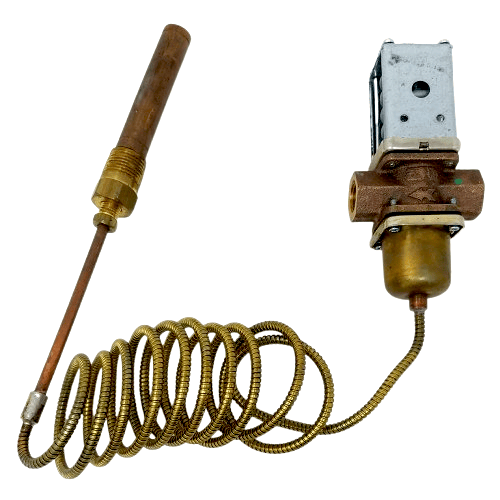
The V47 family mirrors the V46’s size structure: threaded bodies from 3/8 in. through 1-1/4 in., flanged bodies at 1-1/2, 2, and 2-1/2 in., with the same size letters (A through E threaded, R, S, T flanged). What changes is the selection logic. Instead of pressure ranges and refrigerant classes, a V47 is picked by temperature range and range type, and every valve ships with its sensing bulb and capillary.
The V47 regulates water or glycol, opening on a temperature rise at the bulb. Published ranges run from 20 to 65°F at the low end up to 160 to 230°F at the top, with three ranges typically available per valve size. Heating ranges are for applications where the bulb runs well above the ambient air around the valve, such as engine jackets, oil coolers, and process heating loops. These use a compact 3-1/4 or 6 in. bulb. Cross-ambient ranges are for applications where the bulb temperature can cross the ambient temperature at the valve. These models carry a special thermal charge and a longer bulb so the capillary and valve-body temperature can’t fool the sensing element. If the sensed temperature will ever run near or below the air temperature where the valve is mounted, spec the cross-ambient model.
Representative V47 models
| Model | Size | Range (°F) | Range type | Bulb size (in.) |
|---|---|---|---|---|
| V47AA-1C | 3/8 in. NPT | 115 to 180 | Heating | 11/16 x 3-1/4 |
| V47AA-2C | 3/8 in. NPT | 160 to 230 | Heating | 11/16 x 3-1/4 |
| V47AA-3C | 3/8 in. NPT | 75 to 135 | Cross ambient | 11/16 x 6 |
| V47AB-27C | 1/2 in. NPT | 40 to 85 | Cross ambient | 11/16 x 10 |
| V47AC-3C | 3/4 in. NPT | 115 to 180 | Heating | 11/16 x 3-1/4 |
| V47AC-4C | 3/4 in. NPT | 160 to 230 | Heating | 11/16 x 3-1/4 |
| V47AC-6C | 3/4 in. NPT | 75 to 135 | Cross ambient | 11/16 x 10 |
| V47AD-1C | 1 in. NPT | 75 to 135 | Cross ambient | 11/16 x 16-1/4 |
| V47AD-3C | 1 in. NPT | 160 to 230 | Heating | 11/16 x 6 |
| V47AE-1C | 1-1/4 in. NPT | 75 to 135 | Cross ambient | 11/16 x 16-1/4 |
| V47AR, V47AS, V47AT | 1-1/2, 2, 2-1/2 in. | Per range chart | Flanged | Per model |
5. Identifying an Unlabeled or Corroded Valve
Water regulating valves outlive their nameplates. These valves run for decades in wet, scaled, sometimes salty service, and by the time one fails, the data plate is often unreadable and the equipment documentation is long gone. Here’s how to identify what you have from the valve itself, in rough order of reliability.
1. Follow the capillary. This settles the family question in seconds. If the capillary runs to a fitting on the refrigerant piping, usually a 1/4 in. flare connection near the compressor discharge or liquid line, the valve is a V46. If it ends in a cylindrical sensing bulb strapped to a pipe, sitting in a well, or immersed in a tank, the valve is a V47. A V46’s element senses pressure and must connect to the refrigerant circuit; a V47’s element senses temperature and must touch the controlled medium. There are no exceptions.
2. Check for an ammonia-style connection. If there’s no capillary at all and instead a rigid 1/4 in. female NPT pressure connection at the bellows housing, you’re looking at an ammonia-service V46. Stainless bellows, R-717 duty.
3. Read the body and connection type. Size is measurable even when the plate isn’t readable: 3/8 through 1-1/4 in. NPT threaded bodies, or 1-1/2 through 2-1/2 in. four-hole ASME flanges. Brass bodies indicate 3/8 through 3/4 in. commercial valves; cast iron with a rust-resistant finish indicates the larger commercial sizes; naval bronze indicates a maritime or Navy model, and on those, the wetted trim is monel.
4. Determine direct or reverse action. If the valve serves condenser water and opens as the system loads up, it’s direct acting (V46A family). If it sits in a bypass line and opens as pressure falls, it’s a reverse-acting V46N. When the system can’t be run, the giveaway is the piping logic: a valve in the main condenser water supply is almost always direct acting, while a valve in a bypass loop around a heat exchanger or back to a source is the reverse-acting candidate.
5. Use the differential as a confirmation. If the valve still operates, the built-in differential identifies the family: pressure-actuated valves close roughly 3 to 7 psi below their opening point, temperature-actuated valves close roughly 3 to 5°F below theirs. Watching what the valve responds to, a gauge or a thermometer, is the functional version of following the capillary.
6. Repair Kit or Replace?
Johnson Controls publishes repair parts for both families: seat repair kits (the STT series), replacement power elements (SEP for pressure elements, SET for temperature elements), and replacement wells. On paper, a V46 or V47 is a rebuildable valve. In practice, replacement is the right call far more often than a rebuild, and it’s worth being clear about why.
A repair kit addresses one failure at a time. A seat kit fixes seat erosion; a power element fixes a lost charge or ruptured bellows. But the conditions that kill these valves rarely damage just one part. The same years of scale, sediment, and erosion that wear the seat also attack the spring, the guide surfaces, and the body passages. Rebuilding a heavily scaled valve puts new parts into a worn body, and the labor is real: the valve comes apart in place, but diagnosing which element failed, sourcing the right kit for the exact model and vintage, and setting the valve back up takes a service call’s worth of time either way.
A new valve resets everything at once, carries the current construction, and installs in the same footprint with the same connections. For the threaded commercial sizes, the price difference between a kit plus labor and a complete valve is often small enough that replacement is the cheaper total decision, and it’s certainly the more predictable one.
Where a repair kit genuinely earns its place: a large flanged valve where the body represents most of the cost, a built-to-order model (maritime, Navy, ammonia) where a replacement valve has a lead time the plant can’t absorb, or a fleet-maintenance program that stocks elements for scheduled overhauls. In those cases, note that seat kits are shared between the V46 and V47 at matching sizes (the STT14A-600R serves both 3/8 in. families, for example), while power elements are family-specific: SEP pressure elements for the V46, SET temperature elements for the V47. An element swap never converts one family into the other.
7. Source Your V46 and V47 Valves From TCI Supply
Whether you need a stock V46AC for a condenser, a cross-ambient V47 with the right range for a process tank, or a built-to-order maritime or ammonia model with a lead time worth planning around, the fastest path is the same: send us the model number from the nameplate, or a photo of the valve and where its capillary goes if the plate is gone. We’ll confirm the exact replacement and get you a quote. Contact TCI Supply or call us at 1-800-755-2883.