
Do You Need a Honeywell Linkage, or Can You Direct-Couple?
Understanding Actuator Families, Valve Compatibility, and Direct-Couple Selection

Every Honeywell actuator-to-valve installation comes down to one of two outcomes: either the actuator connects directly to the valve with no intermediate hardware (direct-couple), or you need a specific linkage kit between them. Which outcome applies depends on the valve size, the valve style, and the type of actuator.
Get this decision right and the installation is a 20-minute job with parts that ship together. Get it wrong and you’re either stuck with an actuator that won’t physically mount to your valve, or you’ve bought a linkage you didn’t need. The Honeywell catalog publishes four common linkage families, and each one has a specific job.
For everything else, meaning most modern hydronic zone valves, most ball valves, and any threaded globe valve up to 2 inch paired with a direct-couple actuator, the answer is no linkage needed.
Most people landing on this page are in one of three situations. Either you have an actuator and a valve in front of you and you’re trying to figure out whether they connect directly or need a linkage between them, you have an existing installation with a failed linkage and you need to confirm the exact part number to reorder, or you’re maintaining a legacy Modutrol IV system with Q5001 linkages and evaluating whether to keep it running or migrate to direct-coupled actuators. This guide covers all three.
Table of Contents
- → The Four Honeywell Linkage Families at a Glance
- → The Decision: Do You Need a Linkage?
- → The Complete Honeywell Actuator-to-Valve-to-Linkage Matrix
- → Q5020 and Q5024 in Detail
- → Q5001 in Detail: The Modutrol IV Linkage
- → Direct-Couple Installation: The No-Linkage Majority
- → Source Your Honeywell Actuators, Valves, and Linkages From TCI Supply
- → Frequently Asked Questions
The Four Honeywell Linkage Families at a Glance
Honeywell publishes four linkage families that cover essentially every current and legacy actuator-to-valve pairing. Knowing which one you’re looking at is most of the decision.

- Q5020 Globe Valve Linkage. Connects a rotary direct-coupled actuator (MS/MN series) to a globe valve up to 3 inch for MS / up to 6 inch for MN. Used when the actuator itself supports direct-couple mounting but the valve is a larger flanged design that doesn’t accept the actuator’s threaded collar. Compatible with V5011A/B two-way and V5013B/C three-way flanged globe valves, typically 2½ to 3 inch.
- Q5024 Globe Valve Linkage. Same concept as the Q5020, extended to the larger flanged globe valves. Compatible with V5011A/B and V5013B/C valves up to 6 inch. When a direct-coupled actuator meets a flanged valve too large for the Q5020, this is the answer.
- Q5001 Valve Linkage. The classic Modutrol IV linkage. Connects an M6, M7, or M9 Modutrol motor to a V5011 or V5013 globe valve, whether threaded or flanged. Q5001s are still in active service in thousands of legacy HVAC and process installations, and Honeywell continues to publish them in current catalogs specifically to support ongoing maintenance of those systems.
- Q209 and Q607 Legacy Linkages. Older Modutrol IV linkage kits used on some legacy ball valve applications. Largely superseded by direct-coupled ML-series ball valve actuators for new work, but still in service where the original design specified them. Sourcing these often means the secondary market.
The Decision: Do You Need a Linkage?
Three questions resolve almost every actuator-to-valve pairing in the Honeywell catalog. Work through them in order and you’ll land on either “direct-couple, no linkage” or a specific linkage part number.
Question 1: What actuator family are you working with?
Start with the actuator, not the valve, because the actuator family determines which linkages are even in play.

- Linear valve actuator (ML6420, ML7420, ML6421, ML7421, ML6425, ML7425, ML6984, ML7984 series)? Direct-couple, on threaded and flanged globe valves alike. No linkage needed. Done.
- Ball valve actuator (ML6161, ML6174, ML6184, ML7161, ML7174, ML7184 series)? Direct-couple to Honeywell VBN ball valves. No linkage needed. Done.
- Pneumatic actuator (MP953 series)? Direct yoke mount on V5011, V5013, and VGF valve assemblies. No linkage needed. Done.
- Rotary direct-coupled actuator (MS/MN series, the damper-style DCAs rated in lb-in)? You need a Q5020 or Q5024 linkage to drive a globe valve. Go to question 2.
- Modutrol IV motor (M6, M7, or M9 series)? You need a Modutrol linkage. Go to question 3.
If your actuator doesn’t fit any of the categories above, you may be looking at legacy hardware (V4055/V4062 fluid-power, or an older Modutrol series). Send us the actuator model number and we’ll identify the family and the compatible linkages.
Question 2: Rotary DCA — which linkage fits your valve?

You’re here because you’re driving a globe valve with a rotary MS/MN actuator, usually for spring-return fail-safe action or plant standardization.
- Honeywell globe valve up to 3 inch (V5011, V5013, VGF, threaded or flanged)? You need a Q5020. Model selection (Q5020A, C, or D) depends on the valve’s stroke and shaft size; confirm against the valve’s product data.
- Globe valve from ½ inch to 6 inch, or a non-Honeywell globe valve? You need a Q5024, with the bonnet adapter matched to your valve.
- One caution: match the linkage stroke to the valve stroke. A ½-inch-stroke Q5020D on a shorter-stroke valve only rotates the actuator hub through part of its travel, which costs control resolution in modulating service. Fine for two-position; verify for modulating.
Question 3: Is this a Modutrol IV installation?

If you got here from question 1, the actuator is an M6, M7, or M9 Modutrol motor. Now the question is which linkage and which valve.
- V5011 or V5013 globe valve (threaded or flanged, any size in the standard range)? You need a Q5001 linkage.
- Legacy ball valve application? You’re likely looking at Q209 or Q607, both of which are older kits still in service. Send us the actuator and valve model numbers and we’ll identify the correct part.
- Damper application? You need a Modutrol linkage kit for damper service (not Q5001), which is covered in our separate Modutrol IV article.
The short version
For quick reference:
- linear ML actuator + any globe valve = no linkage.
- Ball valve actuator + VBN ball valve = no linkage.
- Pneumatic MP953 + V5011/V5013/VGF = no linkage.
- Rotary MS/MN DCA + globe valve = Q5020 (up to 3″) or Q5024 (up to 6″, any manufacturer).
- Modutrol IV + V5011/V5013 = Q5001.
Everything else is either legacy hardware (Q209, Q607) or an application-specific engineering question worth a phone call.
The Complete Honeywell Actuator-to-Valve-to-Linkage Matrix
The table below covers every standard pairing in the Honeywell ball valve and globe valve actuator lineup, verified against Honeywell’s published product data. Find your actuator family in the left column; the linkage answer follows.
| Actuator family | Example models | Compatible valves | Connection method | Linkage required |
|---|---|---|---|---|
| Linear valve actuator, 135 lbf | ML6420A, ML7420A | V5011N/V5013N threaded (½”-2″), VGF flanged globe | Direct-couple, threaded collar | None |
| Linear valve actuator, 160 lbf | ML6421A, ML7421A (B models for larger single-seated flanged valves) | V5011N/V5013N threaded, VGF flanged globe | Direct-couple, threaded collar | None |
| Linear valve actuator, 320-405 lbf | ML6425A/B, ML7425A/B | V5011/V5013 threaded, VGF flanged globe (to DN80) | Direct-couple, threaded collar | None |
| Self-contained valve actuator | ML6984, ML7984 | V5011 2-way, V5013 3-way (½”-1″ stroke) | Direct-mount | None |
| Pneumatic valve actuator | MP953 series | V5011, V5013, VGF assemblies | Direct yoke mount | None |
| Rotary DCA, spring return (25, 50, 142 lb-in) | MS series direct-coupled actuators | 2-way and 3-way globe valves up to 3″ (DN80), threaded or flanged | Rack-and-pinion linkage converts rotary to linear | Q5020 (A/C/D models by stroke and shaft) |
| Rotary DCA, non-spring return (35, 70, 150, 300 lb-in) | MN series direct-coupled actuators | 2-way and 3-way globe valves up to 3″ (DN80), threaded or flanged | Rack-and-pinion linkage converts rotary to linear | Q5020 |
| Rotary DCA, spring or non-spring | MS/MN series | Globe valves ½” through 6″, Honeywell and most other manufacturers | Rack-and-pinion linkage with bonnet adapters | Q5024 |
| Modutrol IV motor | M6285, M7284, M9184, and related M6/M7/M9 series | V5011 2-way, V5013 3-way (threaded and flanged) | Crank-arm linkage | Q5001 |
| Modutrol IV motor | M6/M7/M9 series | Legacy ball valve applications | Legacy linkage kits | Q209 or Q607 (legacy; secondary market) |
| Ball valve actuator, spring return | ML6161, ML6174, ML6184 | VBN series ball valves | Direct-couple drive shaft | None |
| Ball valve actuator, non-spring return | ML7161, ML7174, ML7184 | VBN series ball valves | Direct-couple drive shaft | None |
| Fluid-power actuator | V4055, V4062 | Gas safety shutoff valve bodies (combustion service) | Direct-mount | None |
Reading the matrix

- The linkage question is an actuator question, not a valve question. Every linkage row in the table is driven by the actuator family: rotary DCAs need Q5020/Q5024, Modutrol IV motors need Q5001, and everything else direct-couples. The same 2-inch V5011N valve can be actuated four different ways — linear ML actuator (no linkage), rotary DCA (Q5020), Modutrol IV (Q5001), or pneumatic MP953 (no linkage) — and Honeywell publishes all four as standard options.
- Why choose a rotary DCA plus a Q5020 over a direct-couple linear actuator? The main reason is spring return. The linear ML6420/ML7420 family is predominantly non-spring-return; if your application requires fail-safe spring action on a globe valve (valve drives closed or open on power loss), the standard path is a spring-return rotary DCA (25, 50, or 142 lb-in) with a Q5020 or Q5024 linkage. Plant standardization is the second reason: facilities running MS/MN rotary actuators on dampers can stock one actuator family for both damper and valve service.
- Q5024 works on non-Honeywell valves. Honeywell publishes the Q5024 as compatible with globe valves “made by most manufacturers” from ½ inch through 6 inch, with bonnet adapters handling the valve-side fit. If you’re actuating a non-Honeywell globe valve with a Honeywell rotary DCA, the Q5024 is the bridge.
- Close-off ratings depend on the full stack. The published example from the Q5020 data: a 2-inch V5011N (Cv 46.8) with a Q5020A and a 75 lb-in non-spring rotary DCA delivers 53 psid close-off. The same linkage with different valves and actuator torques scales differently, and Honeywell publishes close-off tables per combination. Verify your specific stack against the valve’s product data before ordering; undersized close-off is the most common cause of a valve that won’t seat.
- One stroke-matching caution on the Q5020D. The Q5020D is the ½-inch-stroke model. Used with a shorter-stroke valve (Honeywell notes 5/16-inch-stroke Johnson Controls valves as the example), the DCA hub rotates only about 56° of its 90° stroke, which costs you a third of the control resolution in modulating service. Fine for two-position; check it for modulating.
Q5020 and Q5024 in Detail
Both linkages do the same mechanical job: a steel rack-and-pinion mechanism in an aluminum die-cast housing that converts a rotary DCA’s 90-degree stroke into the linear stem travel a globe valve needs. Both install without disassembling the actuator or the valve, mount in flexible orientations, and include an adjustable manual override lever and a valve position indicator. The differences are range and fit.
Q5020: the Honeywell-valve linkage, up to 3 inch

The Q5020 covers 2-way and 3-way globe valves up to 3 inch (DN80), in both modulating and two-position service. On the actuator side, it accepts Honeywell’s 25, 50, and 142 lb-in spring-return DCAs and the 35, 70, 150, and 300 lb-in non-spring-return DCAs.
The family ships in multiple models (Q5020A, Q5020C, Q5020D) matched to the valve’s stroke and stem shaft size; the Q5020A1003/U, for example, is the ½-inch-shaft model, and the Q5020D is the ½-inch-stroke model. Model selection depends on the specific valve, so confirm against the valve’s product data or send us both part numbers.
Two practical details from Honeywell’s published data are worth knowing:
- Close-off ratings scale with the full stack. Honeywell’s worked example: a 2-inch V5011N (Cv 46.8) with a Q5020A and a 75 lb-in non-spring DCA delivers 53 psid close-off. For a similar valve with a different Cv, the approximation scales inversely with Cv (a Cv 40 valve in the same stack approximates 62 psid), though Honeywell notes this is an estimate and publishes exact tables per combination. If your system’s differential pressure is anywhere near the published close-off number, verify against the tables rather than the approximation.
- Stroke mismatch costs control resolution. The Q5020D’s ½-inch stroke paired with a shorter-stroke valve (Honeywell cites 5/16-inch-stroke Johnson Controls valves) rotates the DCA hub through only about 56 of its 90 degrees. In modulating service, that means only two-thirds of the control signal maps to actual valve travel, which coarsens your control resolution. For two-position open/close service it doesn’t matter; for modulating loops, match the linkage stroke to the valve stroke.
One boundary note: for single-seated flanged valves larger than the Q5020’s published range, Honeywell’s answer isn’t a bigger linkage; it’s a higher-force direct-coupled linear actuator (the ML6421B or ML7421B). The rotary-DCA path has a size ceiling.
Q5024: the wide-range linkage, including non-Honeywell valves
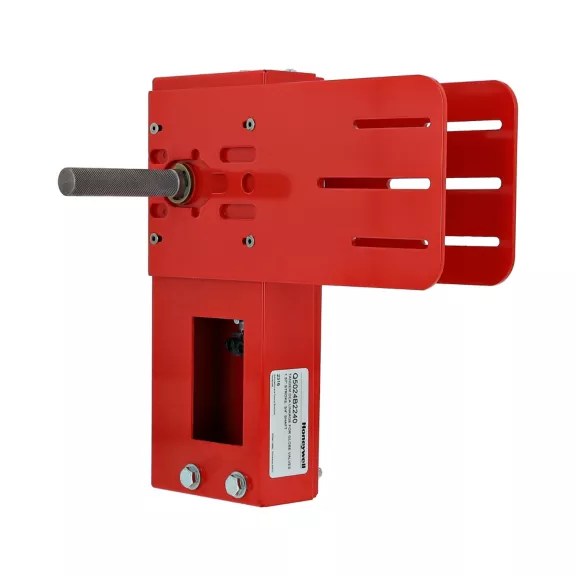
The Q5024 extends the same rack-and-pinion concept across globe valves from ½ inch through 6 inch, and Honeywell explicitly publishes it as compatible with globe valves “made by most manufacturers.” The valve-side fit is handled by bonnet adapters matched to the specific valve, so a Q5024 order is really a linkage-plus-adapter pairing.
That manufacturer-agnostic range is the Q5024’s real value. If you’re standardizing a mixed-vendor plant on Honeywell MS/MN actuators, or you need spring-return fail-safe on a globe valve that isn’t a Honeywell body, the Q5024 with the right bonnet adapter is the published path.
Picking between them
The decision is simple: Honeywell globe valve up to 3 inch, Q5020. Anything bigger, or any non-Honeywell valve, Q5024 with the matched bonnet adapter. Both need the model or adapter confirmed against the specific valve, which is a part-number question we can answer from the valve nameplate.
Q5001 in Detail: The Modutrol IV Linkage

The Q5001 connects a Modutrol IV motor (M6, M7, or M9 series) to a V5011 2-way or V5013 3-way globe valve, threaded or flanged. It’s a crank-arm linkage: the Modutrol motor’s rotary crankshaft drives the valve stem through the linkage’s lever mechanism. One linkage family, one actuator family, one valve family, which makes the selection simple: if you have a Modutrol motor on a V5011 or V5013, the Q5001 is your part.
Thousands of legacy HVAC and process installations still run this combination, and Honeywell keeps the Q5001 in the current catalog specifically to support them. Close-off ratings depend on the motor’s torque rating; Honeywell’s valve product data publishes them per combination (a Modutrol motor with Q5001 on a 2-inch V5011N reaches 98-126 psid, notably higher than most DCA and linear-actuator stacks on the same valve, which is part of why these systems have stayed in service).
Keep it running or migrate? The practical answer for most plants: replace like-for-like as long as the motor and linkage are serviceable and available. A failed Q5001 is a linkage swap; a failed Modutrol motor is a motor swap. Both parts remain sourceable, and the surrounding control wiring and valve stay untouched. Migration to a direct-coupled linear actuator (ML7420 family) makes sense when the motor and linkage are both at end of life, when you’re already re-piping or re-valving, or when the control system upgrade demands a modulating signal the old motor setup can’t take cleanly. Migrating means new mounting, new wiring, and a close-off check against the replacement actuator’s force rating, so it’s a planned-shutdown project, not an emergency fix.
Direct-Couple Installation: The No-Linkage Majority
Most Honeywell actuator-valve pairings need no linkage at all. For completeness, here’s what direct-couple installation looks like across the three main families.
Linear ML actuators on globe valves (ML6420/ML7420 through ML6425/ML7425)
Retract the actuator stem fully using the manual override, thread the actuator’s captive collar onto the valve bonnet, torque to spec, and connect the stem connector between the actuator and valve stems. Stroke the valve through full travel to verify. Works identically on threaded and flanged valves in the published range.
Ball valve actuators on VBN valves (ML6161-ML7184)
Set both valve and actuator to closed, align the drive shaft with the valve stem, attach with the supplied hardware, torque per the instructions, verify travel. VBN valves also ship factory pre-assembled with actuators; those install as one unit.
Pneumatic MP953 on V5011/V5013/VGF
Standard yoke mounting to the valve bonnet, then connect the air line and control signal. No electrical linkage considerations.
Before you order any combination, linkage or not, confirm five specs:
- Close-off rating meets or exceeds your worst-case differential pressure (this is force/torque matching, and it’s the most common failure point; check the valve’s published tables for your exact actuator stack).
- Supply voltage matches the control circuit.
- Control signal type matches the controller output (two-position, floating, or modulating).
- Pipe size matches the line.
- Pressure-temperature rating covers your system’s worst case. Any mismatch means sourcing the correct part, not forcing the install.
Source Your Honeywell Actuators, Valves, and Linkages From TCI Supply
Whether you need a Q5020 to put spring-return on a globe valve, a Q5001 to keep a legacy Modutrol IV system running, a Q5024 bonnet adapter matched to a non-Honeywell valve, or confirmation that your pairing direct-couples with no linkage at all, the fastest path is the same: send us the actuator model number, the valve model number, and the pipe size.
We’ll confirm the right combination, including the linkage model and adapter where one is needed, and get you a quote. Legacy linkages like the Q209 and Q607 are exactly the kind of parts we source through the secondary market when standard channels come up empty. Contact TCI Supply or call us at 1-800-755-2883.